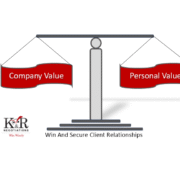
To Win And Secure Client Relationships, Add Personal Value
At my negotiation firm, we have often written about the topic of personal value since it is so important to effective negotiation strategies, particularly in a B2B environment. The ability to communicate clearly and persuasively is fundamental to winning profitable deals and building strong client relationships. When you are understood and believed, you can greatly increase your chances of securing positive leverage based on the value you provide to the other side.
As business leaders, we frequently view value as something our business does for our counterparts. However, we sell ourselves short if our communication doesn’t demonstrate at least two kinds of value:
- Company value for them.
- Personal value to their representatives.
You generate company value by making the deal beneficial to the customer’s organization. This could entail improving their company’s bottom line, increasing revenues, improving their return on assets, expanding market share, reducing costs or enhancing any of their specific key performance indicators (KPIs). To put this another way, the company believes it is better off doing the deal with you because their organizational objectives are achieved.
But you should never forget that the individuals within the organization each have their own goals, concerns and pressures. For example, a chief information or risk officer (CIO or CRO) may need reassurance that you provide rock-solid data security if their company happens to be the target of an embarrassing breach or is subject to additional regulations currently affecting their industry. Likewise, an ambitious sales executive may want to know how you can help them position themselves for performance recognition and career advancement while meeting organizational goals.
You can accomplish this by conducting your own research, listening carefully and seeking opportunities to build value for the individual while still focusing on company and individual KPIs. This approach can turbocharge your value proposition and increase the appeal of your offering—whether it’s a product, service or partnership opportunity.
The best way to generate personal value is to provide legitimate individual benefits to the people on the other side who are involved in the transaction. (Note that this does not include illicit personal benefits or commercial bribes!) Good negotiators know how to consistently demonstrate 360 degrees of value. This could include boosting your counterpart with credibility and prestige among their peers, bosses and others inside and outside the organization.
For example, a number of years ago, I was working on an alliance with a Japanese company that had a technical guru who challenged one of our assumptions. It turned out that the third-party data he used was incorrect. As a result, he was losing face in the negotiation with us as well as his own team. This was not good as it was important to keep this individual and his critical skills involved in our alliance efforts. In one of our subsequent meetings, I made sure to praise his efforts and logic that he would have yielded the correct result with the correct data. His demeanor and posture changed immediately, as did his team’s. The alliance was successful, as was the long-term relationship with him.
Delivering personal value will help you close not only the current deal but also secure you for the future as you build strong relationships with people who know that their success is your priority.
Your mindset should be such that you are constantly alert to opportunities to provide enhanced value. Exploratory conversations may reveal individual pressures/concerns that you can help solve. This can be as simple as taking extra steps that make it easier for your counterparts to present your solution internally to their peers and decision makers. In such a case, helping them define both the current and future states of their business would be invaluable. And if your solution is perceived as an element of getting them to the future state, it will find a much easier sales path. Remember that problem-solvers are always valued.
More often than not, personal value can be defined as making your counterpart’s job easier. A client of ours was recently confronted with a situation where her customer’s VP liked her offering but faced delays in obtaining buy-in from his decision makers, including the CFO because he didn’t have the time or resources to complete a business case justifying the investment. Our client became a value-added problem-solver and facilitated the process. She helped the VP by crafting a business case using the customer’s own data that demonstrated their return on investing with her and her company. The VP appreciated the effort and used the business case with a few modifications to secure the purchase. In this case, everyone won—the seller’s company, the seller, her counterpart and the customer.
An important corollary occurs later in the process—as value is delivered after the sale is completed—when we should be affirming the decision the client made to do business with us. We call this affirming client value (ACV), which validates your counterpart’s decision, securing their status as well as your position for the next deal. It is a type of personal and company value recognition that is critical for long-term relationships.
When we widen our vision to include the personal dimension, we find that we often discover multiple options for moving deals forward. If you have a solid, quantifiable value argument for a prospect, look and listen carefully for ways you can tie that to an individual’s desire to increase productivity, advance their career, free up time or even simplify their day. Many successful deals and profitable relationships are built on recognizing and demonstrating personal as well as company value.
Note: this article originally appeared in December, 2024 on Forbes.com. You can view the original post here.


 On the eve of his November meeting with feared Russian light heavyweight Sergey “Krusher” Kovalev, the New York Times took a